
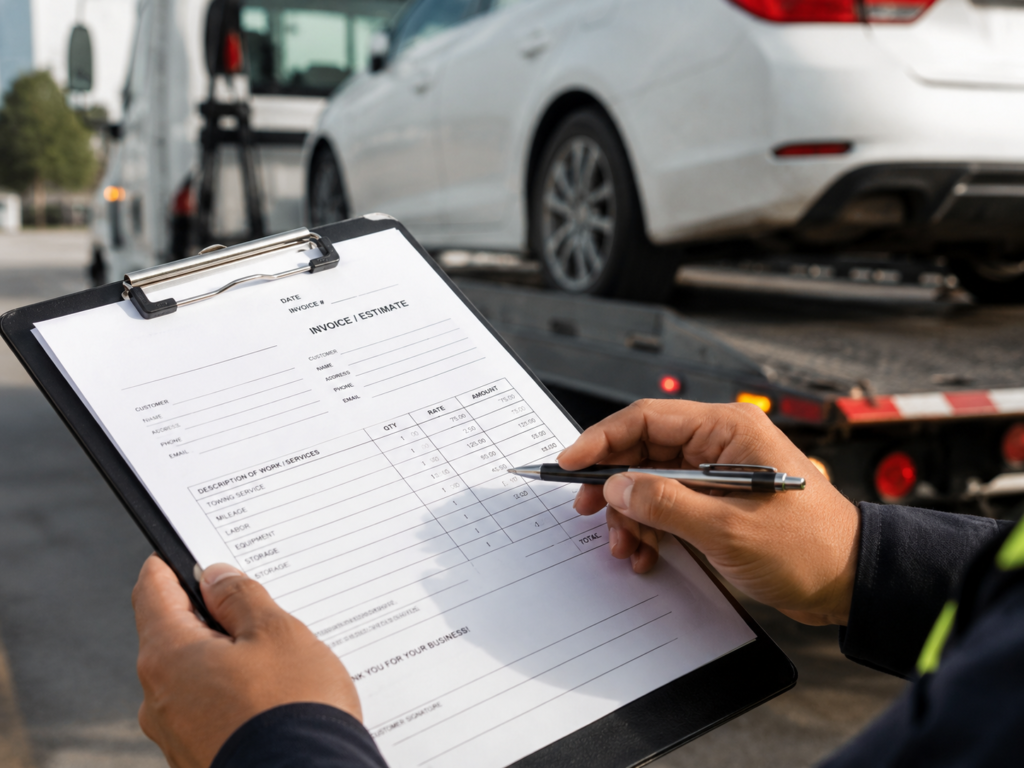
How much does a tow cost?” is one of the most common questions people search right before they need one – usually while standing next to a car that won’t start. The honest answer is: it depends on a handful of specific factors, and any towing company that gives you a flat number without knowing your situation is probably rounding in their own favor.
Here’s what actually goes into a towing bill in New Jersey, and what the law says about what a company can and can’t charge you.
What Affects the Price of a Tow
Distance. Most local tows are priced with a base fee plus a per-mile rate once you’re past a certain distance from the shop or drop-off point. A tow across town costs less than one that crosses county lines.
Vehicle type. A standard sedan costs less to tow than an SUV, pickup, or anything heavier – larger vehicles need more powerful equipment and take longer to load safely.
Time of day. Nights, weekends, and holidays typically cost more than a weekday afternoon tow, since it requires a company to staff around the clock rather than during normal business hours.
Tow method. A flatbed tow, where the whole vehicle rides on a platform, generally costs more than a wheel-lift tow, but it’s gentler on the car – worth it for AWD vehicles, low-clearance cars, or anything with existing damage.
Type of tow. A tow you request yourself (breakdown, accident, roadside help) is a different situation than a non-consensual tow – for example, a car towed off private property without the owner’s involvement. New Jersey treats these differently under the law, which matters for what you can be charged.
What New Jersey Law Actually Says
New Jersey doesn’t leave towing fees completely unregulated. A few protections worth knowing:
- Storage fee cap. Under New Jersey’s Predatory Towing Prevention Act, storage fees for a towed vehicle are capped, and companies are required to give written notice within a set window rather than let storage charges quietly pile up.
- “Reasonable fee” standard for non-consensual tows. If your car is towed without your direct request – say, from a private lot – state guidance treats a fee as reasonable if it’s in line with what the same company charges for a tow the owner actually requested, or in line with what other local companies charge for the same job. A fee far outside that range is a red flag.
- Municipal rate rules. Many New Jersey towns and cities set their own maximum towing rates by local ordinance, and licensed towers are generally required to post their rates where customers can see them before a tow happens.
- Right to an estimate. You’re entitled to ask for pricing information before authorizing a tow whenever that’s practical – a company that won’t give you a straight answer over the phone is worth being cautious about.
So What Should You Actually Expect to Pay?
Across New Jersey, a standard local tow (regular passenger vehicle, reasonable distance, daytime) commonly falls in a fairly moderate range, with after-hours, long-distance, oversized vehicles, or flatbed service pushing the price higher. The specific number for your situation depends on where you are, what you’re driving, and when you’re calling – which is exactly why a real quote requires a real phone call, not a generic number pulled from a website.
If you ever feel a bill came in well above what’s reasonable for the job, you’re allowed to ask for an itemized breakdown, and you can raise the issue with New Jersey’s consumer protection office if it doesn’t add up.
If You’ve Been Towed From Private Property
Private property towing has its own set of rules around signage, notice, and what a lot owner can and can’t do before calling a tow truck. If that’s the situation you’re dealing with, our private property towing page breaks down how that process works in New Jersey.
Getting an Actual Quote
The only way to get a real number is to call and describe your situation – vehicle type, location, and what’s going on. We quote pricing over the phone before dispatching a truck, so you know what to expect before anyone shows up. If you’re dealing with a standard breakdown rather than a towed vehicle, our vehicle recovery service covers that directly.
Where We Provide Towing in New Jersey
Pricing and response times can vary depending on where you’re located, so it helps to know whether you’re in our regular service area before you call. We cover East Orange and the surrounding communities, including nearby towns in Essex County.
If you’re not sure whether your location is covered, check our full list of service areas or just call and tell us where you are – we’ll confirm right away.
Common Questions
Is towing more expensive at night in NJ? Generally yes. After-hours, weekend, and holiday service tends to cost more than a daytime call, since it requires round-the-clock staffing.
What’s the cheapest way to get towed in NJ? “Cheapest” isn’t always the safest choice – an unusually low quote can mean hidden fees added later, or a company cutting corners on insurance. A transparent, upfront quote from a licensed company is usually the better value, even if the number isn’t the lowest one you see.
Can a towing company charge me whatever they want? No. New Jersey regulates towing fees at both the state and municipal level, with specific protections around storage costs, notice requirements, and what counts as a reasonable fee for a non-consensual tow.
How do I know if I’ve been overcharged? Ask for an itemized bill. If the total looks far outside what’s typical for the distance and vehicle type, you can raise it with the company directly or file a complaint with New Jersey’s consumer protection office.
Need a Tow in East Orange or Nearby?
Call (862) 707-2535 and tell us your situation – we’ll give you a straight, upfront quote before anything is dispatched.
Leave a Reply